위암
이론과 하이라이트 히스토리를 확인 할 수 있어요.
위암
1. 위선암 (Gastric adenocarcinoma)
• 위에서 발생하는 암의 90%는 선암
1) 병리학적 분류
위 선암은 두가지 주요 형태로 나뉜다:
① Intestinal type (장형)
• 궤양을 동반하는 bulky, exophytic mass를 주로 형성
• 샘 구조로 증식함; 암세포는 다량의 apical mucin vacuole을 지니며 종양 중심 또는 생감에 다량의 점액이 축적됨
② Diffuse type (미만형)
• 개별 세포 또는 소집단 형태로 위벽을 광범위하게 침윤; 샘 구조를 형성하지 않음
- 접착력 상실(E-cadherin 소실)로 인해 세포가 유착력을 잃고 discohesive한 형태로 넓게 퍼짐
• 암세포는 큰 점액 공포가 세포질을 밀어내며 signet-ring cell 모양을 이룸
• 침윤 부위에서 섬유반응(desmoplasia)을 유발하여 위벽이 단단해지고 두꺼워짐 → 병변이 광점위할 경우 rugae와 같음 점막의 주름을 소실하고 가죽과 같은 위벽을 형성하며 이를 linitis plastica라고 칭함
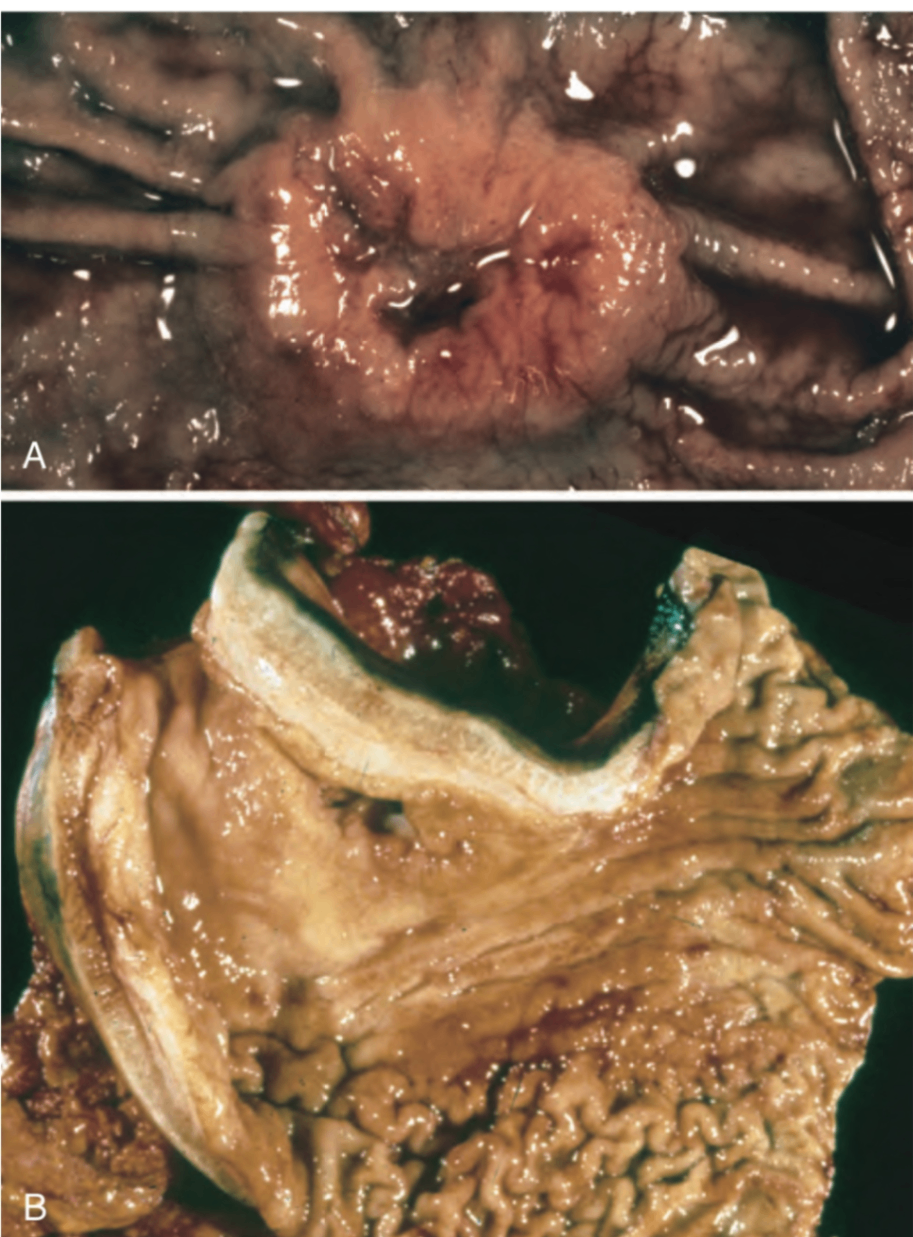
B: infiltrative type (linitis plastica) gastric cancer
Robbins and Cotran Pathologic Basis of Disease, 10e, pg 775
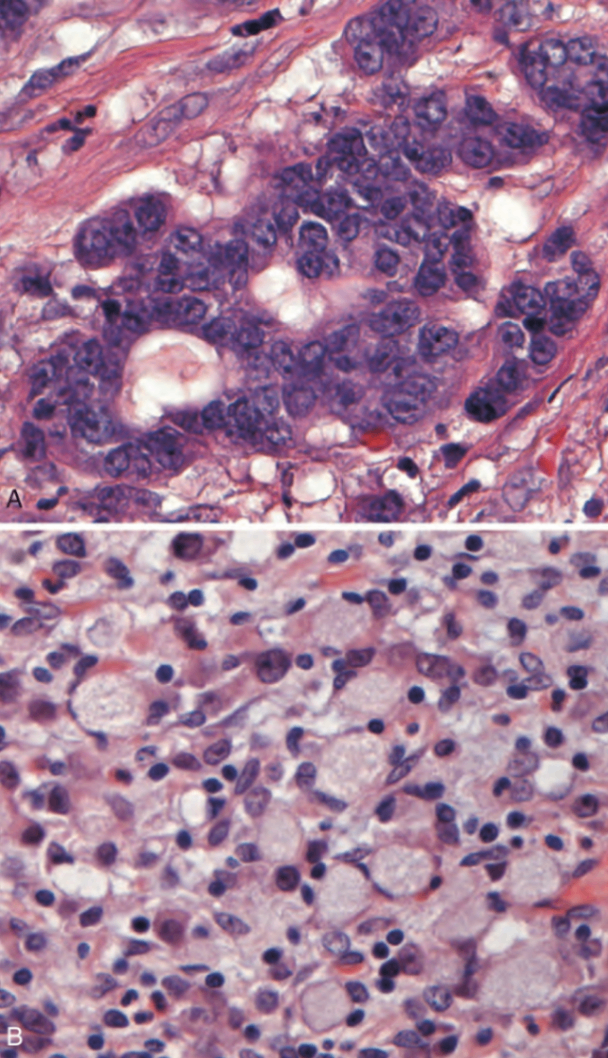
A: intestinal-type adenocarcinoma
B: infiltrative type gastric cancer
Robbins and Cotran Pathologic Basis of Disease, 10e, pg 776
2) 분자 병인
① Intestinal type (장형)
• Wnt 신호 경로 활성화가 주된 분자 병인
- APC 종양억제유전자 소실
※ familial adenomatous polyposis (FAP, germline APC mutation) intestinal-type 위암 위험 증가
- β-catenin gain-of-function mutation
→ 결과적으로 세포 증식 및 생존 신호 증가
② Diffuse type (미만형)
• E-cadherin(CDH1) 유전자 기능 소실
- 세포 간 접착력 상실
- 세포 분극 및 구조 유지 기능 저하
→ 세포의 확산성과 침윤성을 증가시킴
3) 임상적 함의
• 장형은 H.pylori 감염, 위축성 위염 등과 같은 환경 요인과 연관
• 미만형은 유전적 요인의 영향이 강함
• 예후는 병기 및 병리형에 따라 다르며, 미만형이 일반적으로 더 예후 불량
4) 병기
• 위암의 병기 TNM 중 tumor, 즉 원발 종양 깊이가 가장 중요한 예후 인지임
• 위암 병기의 T stage (primary tumor의 depth of invasion)는 다음과 같이 분류된다:
T0 | No evidence of primary tumor |
Tis | Carcinoma-in-situ; intraepithelial tumor without invasion of lamina propria |
T1 | Tumor invades the lamina propria, the muscularis mucosa or the submucosa |
T1a | Tumor invades the lamina propria or muscularis mucosa |
T1b | Tumor invades the submucosa |
T2 | Tumor invades the muscularis propria layer |
T3 | Tumor invades the subserosa layer without invasion of the serosa and adjacent structures |
T4 | Tumor penetrates the serosa (visceral peritoneum) or adjacent structures |
T4a | Tumor penetrates the serosa (visceral peritoneum) |
T4b | Tumor invades adjacent structures |
2. Extranodal marginal zone B-cell lymphoma of MALT type
이론부터 문제까지, 알렌의 서재를 100% 활용하세요
※ 로그인 후 이용권 구매 시 전체 이용 가능합니다.
6,000개 이상의 문제와 연결되는 이론으로 개념과 적용을 한 번에
실제 국시와 동일한 CBT 환경으로 실전 감각 완성
틀린 문제를 매일 자동으로 챙겨주는 ‘오늘의 문제’
메모·암기카드·노트로 만드는 나만의 복습노트